Artificial intelligence, that most enigmatic of modern muses, has already insinuated itself into the realm of crypto trading, where it now serves as a sycophantic oracle for market analysis, news tracking, and the automation of strategies.
Yet, for all its pretensions, AI remains but a squire to the knight of human traders, offering counsel from the shadows rather than wielding the sword of direct action. The core trading infrastructure, that ancient fortress of human control, remains unbreached by these digital sycophants.
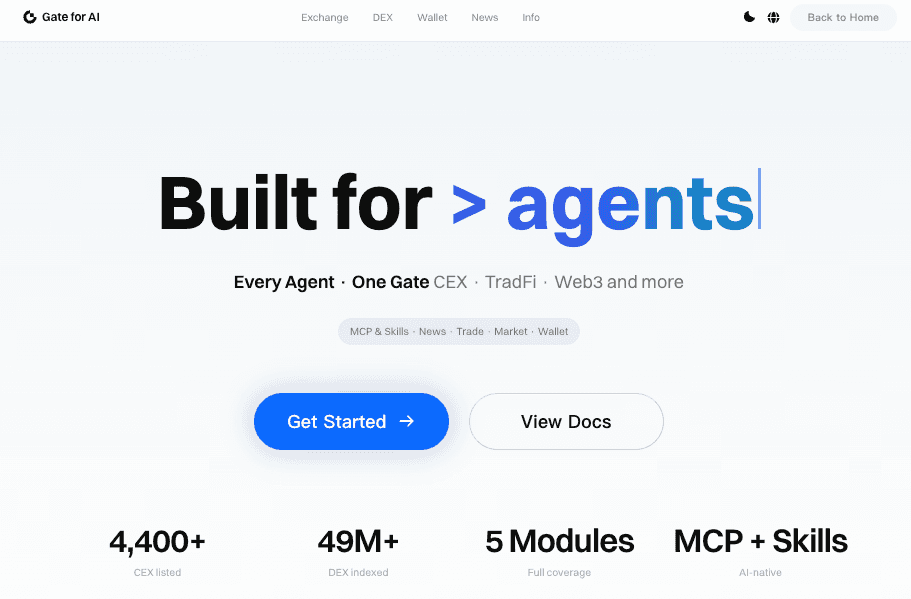
It is here, at this crossroads of innovation and hubris, that Gate dares to upend the status quo. The exchange has unveiled ‘Gate for AI,’ a system so audacious it permits AI agents to don the mantle of direct interaction with trading infrastructure, thereby transforming them from mere scribes to principal actors.
Let us marvel at this spectacle. Instead of treating AI as a third-party tool layered atop an exchange, the platform presents it as an integrated component, a digital alchemist capable of accessing trading, wallets, on-chain data, and real-time market information within a unified environment. A utopia for those who believe machines should govern their own fates.
Let’s take a closer look.
Interfaces for AI-Driven Trading
Gate for AI is structured as a capability interface layer, a gilded cage designed to connect AI models with the operational components of an exchange. Once integrated with ChatGPT, Claude, or other models, the infrastructure allows agents to transcend the realm of simple queries-no longer content to ask for token prices or generate market summaries, they now theorize, strategize, and execute, all while pretending they are not merely following prewritten scripts.
This workflow may include gathering market and on-chain data, analyzing conditions, calculating risk exposure, generating a strategy, and submitting orders that execute against real liquidity. After execution, the system can also monitor trades and review strategy performance-though one wonders if the AI, in its infinite wisdom, will ever admit to errors.
In practical terms, the architecture allows AI to interact with multiple elements of the trading stack in a coordinated way. This includes market data, order execution, and account activity within a single framework. A marvel of modern engineering-or a dystopian nightmare, depending on your perspective.
Five Core Capabilities in One
The platform’s infrastructure combines five functional domains that typically exist across different tools and interfaces. Centralized exchange trading forms the first layer, where AI agents can access spot markets, derivatives trading, and other exchange products through the same system that handles user orders. A triumph of efficiency, or perhaps a testament to the exchange’s penchant for bureaucratic excess.
The second domain covers on-chain trading capabilities, including swap functionality and other decentralized trading interactions. Here, AI agents participate directly in blockchain markets, as if they were not merely algorithms mimicking human behavior. The third domain integrates wallet management and signing infrastructure, enabling agents to create wallets and authorize on-chain actions through secure confirmation mechanisms. One might say it’s a marriage of convenience between silicon and steel.
Beyond trading execution, the system incorporates real-time news and sentiment feeds, providing structured market updates for AI analysis. Finally, on-chain information tools retrieve data about tokens, projects, addresses, and risk indicators. A veritable Swiss Army knife for digital marauders.
Five-in-one > five ones. A slogan so profound it deserves a Nobel Prize in Redundancy.
MCP and Skills
Gate for AI is built around a two-layer system that separates basic connectivity from advanced functionality. The first layer, known as MCP, provides standardized interfaces for core exchange features. These include market data access, account information, order submission, and on-chain queries. The design prioritizes compatibility and straightforward integration with existing AI model ecosystems, though one suspects it is more about control than convenience.
The second layer consists of Skills, which package multiple data sources and logical models into higher-level modules. These modules can perform tasks such as identifying potential arbitrage opportunities, calculating optimal position sizes, or generating structured reports based on risk models. A digital alchemist’s toolkit, if alchemists were prone to overcomplicating simple tasks.
In this structure, MCP serves as the foundation for basic operations, while Skills enable more complex strategy development and analysis. A hierarchy as old as civilization itself, but with fewer humans and more lines of code.
Moving Toward AI-Native Trading Systems
Gate describes the launch as a move from offering trading features to providing an AI-accessible infrastructure layer. Rather than functioning as a simulated environment or sandbox, the system connects AI interactions directly to the exchange’s matching engine and risk management framework. In other words, orders generated through the system interact with the same market liquidity available to regular traders. A bold step toward a world where humans are merely spectators to their own demise.
The goal is to enable AI systems to operate within real market conditions rather than serving purely as analytical assistants. A noble ambition, if one ignores the fact that these systems are still bound by the whims of their creators.
A Step Toward Agent-Native Crypto
The introduction of Gate for AI is part of a growing trend, where agent-driven infrastructure is becoming more prominent in digital finance. One might call it the dawn of a new era, if one were not so certain it is merely the same old story, told with more buzzwords and fewer ethics.
For Gate, the platform represents an early step in building what it describes as an “Intelligent Web3” strategy, with plans to expand strategy modules, risk control tools, and integrations across AI ecosystems. A vision so grand, it would make a Victorian inventor blush.
Whether AI agents will eventually become significant market participants remains an open question. Yet, one suspects the answer lies not in the algorithms themselves, but in the hands of those who code them-a fact that should terrify us all.
Read More
- LSETH PREDICTION. LSETH cryptocurrency
- EUR TRY PREDICTION
- AVAX PREDICTION. AVAX cryptocurrency
- USD CLP PREDICTION
- EUR IDR PREDICTION
- GBP RUB PREDICTION
- DOGE PREDICTION. DOGE cryptocurrency
- USD UAH PREDICTION
- ADA PREDICTION. ADA cryptocurrency
- USD AUD PREDICTION
2026-03-10 14:00