In the dimly lit chambers of the Ethereum Foundation, where the air is thick with the scent of stale coffee and unfulfilled promises, the protocol track leads have unveiled their latest masterpiece-a “Protocol Priorities Update for 2026.” Published on the 18th of February, this document, penned with the gravity of a man explaining chess to a goat, outlines the grand reorganization of core R&D and the next cycle of upgrades. One can only marvel at the audacity of such planning in a world where the only constant is change.
Ethereum’s 2026: A Year of Grandiose Ambitions
The year 2025, they tell us, was a year of high-throughput theatrics, with mainnet changes anchored by two network upgrades: Pectra in May and Fusaka in December, accompanied by the grand unveiling of PeerDAS. Alongside these, the community, in a fit of exuberance, doubled the mainnet gas limit from 30 million to 60 million, a feat they proudly declare as the first significant jump since 2021. One wonders if they threw a parade.
The main change, they assure us, is organizational. “Now that those milestones are behind us,” the authors write with the air of a man who has just discovered the wheel, “we have the opportunity to think about how we organize our work at a slightly higher level.” For 2026, the Protocol work is grouped into three tracks: Scale, Improve UX, and Harden the L1, each led by individuals whose names sound like they were plucked from a Scandinavian phonebook: Ansgar Dietrichs, Marius van der Wijden, Raúl Kripalani, and so forth.
The Scale track, a pragmatic consolidation of last year’s “Scale L1” and “Scale Blobs” initiatives, is led by a trio whose names alone could form a law firm. Execution capacity, networking, and consensus changes, they explain, tend to land in the same client code and influence each other. One can almost hear the collective sigh of relief from the developers.
On the roadmap, they highlight continued gas limit increases “toward and beyond 100M,” supported by block-level access lists via EIP-7928 and ongoing client benchmarking. They also flag “the scaling components of Glamsterdam,” a name that sounds more like a failed Eurovision entry than a technical upgrade. Enshrined PBS through EIP-7732, repricings, and further blob parameter increases are all part of this grand ballet.
Beyond that, the Scale track includes pushing a zkEVM attester client from prototype toward production readiness, and longer-run state scaling work that spans near-term repricing and history expiry through to binary trees and statelessness. One can only imagine the late-night debates over binary trees.
The Improve UX track, led by Barnabé Monnot and Matt Garnett, narrows in on two areas the foundation calls the most leverage for 2026 usability: native account abstraction and interoperability. Account abstraction, they posit, is the key to a future where smart contract wallets become the default without bundlers, relayers, or extra gas overhead. Proposals like EIP-7701 and EIP-8141, described as “Frame Transactions,” aim to move smart account logic deeper into the protocol itself. One can almost hear the protocol whispering, “Thank you.”
This UX roadmap is also tied to security direction. Native account abstraction, they argue, provides a cleaner migration path away from ECDSA-based authentication, and parallel proposals aim to make quantum-resistant signature verification meaningfully cheaper inside the EVM. Because, as we all know, quantum resistance is the new black.
Interoperability work builds on the Open Intents Framework with the stated goal of “seamless, trust-minimized cross-L2 interactions,” supported by faster L1 confirmations and shorter L2 settlement times. Because nothing says seamless like minimizing trust.
The new Harden the L1 track, led by Fredrik Svantes, Parithosh Jayanthi, and Thomas Thiery, is framed as insurance policy work that preserves Ethereum’s core properties while scaling continues. Tied to Svantes’ Trillion Dollar Security Initiative, it includes post-quantum readiness and execution-layer safeguards like post-execution transaction assertions and “trustless RPCs.” Because, as we all know, a trillion dollars is the new million.
On censorship resistance, Thiery’s scope includes FOCIL via EIP-7805 and extensions that touch censorship resistance for blobs, statelessness work labeled VOPS, and the development of measurable censorship-resistance metrics. Jayanthi’s remit covers devnets, testnets, and client interoperability testing, which becomes more critical if Ethereum moves into a faster fork cadence. Because nothing says critical like faster forks.
Looking ahead, the foundation targets Glamsterdam for the first half of 2026, with Hegotá planned later in the year. The stated ambition bundles parallel execution, significantly higher gas limits, enshrined PBS, continued blob scaling, and progress on censorship resistance, native account abstraction, and post-quantum security. More track-level updates are promised as the year unfolds, because nothing says ambition like a never-ending list of promises.
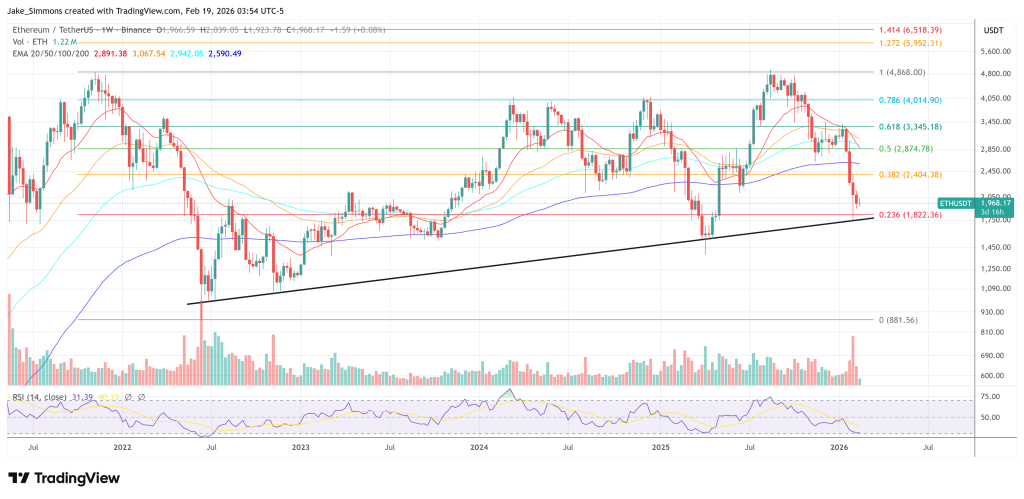
At press time, Ethereum traded at $1,968, a number that, like the protocol itself, is subject to change without notice.
Read More
- XDC PREDICTION. XDC cryptocurrency
- USD JPY PREDICTION
- MNT PREDICTION. MNT cryptocurrency
- USD PLN PREDICTION
- TRX GBP PREDICTION. TRX cryptocurrency
- Ethereum’s Surprising Comeback: Is 2025 the Year of the Blockchain Beast? 🎉🚀
- BNB Surpasses 279M Holders in 2025-Will 2026 Be a Winner?
- Bitcoin Just Lost 8,889 Coins – Chaos Ensues (Or Not)
- ETH Soars Past $3K: Can the “Ghosts of Capitalism” Haunt This Rally? 🧟💸
- Render Token’s Tumultuous Tale: Bulls, Bears, and Breakouts
2026-02-19 19:21