The world of artificial intelligence saw huge changes this week, with new AI models being released, companies receiving massive investments, governments starting to regulate the technology, and people’s opinions rapidly evolving. This indicates that AI is moving beyond just impressive demonstrations and is now being widely adopted around the globe.
Model Wars Heat Up
The week kicked off with a flurry of frontier model releases from nearly every major AI lab. Google rolled out Gemini 3.1 Flash-Lite on March 3, a lower-cost version designed for developers handling large-scale workloads, while continuing to push Gemini 3.1 Pro for advanced reasoning tasks. Google said Flash-Lite delivers similar results for translation and moderation workloads at roughly one-eighth the cost of the Pro model.
OpenAI also released GPT-5.3 Instant, the newest default model powering ChatGPT. The company said the update improves conversational flow and cuts hallucinated answers in web-based queries by about 26.8%. Critics, however, noted that the update focuses heavily on tone and user experience rather than dramatic jumps in raw reasoning ability.
Anthropic added new firepower to its Claude lineup with Claude Opus 4.6 and Sonnet 4.6. The models include context windows reaching up to 1 million tokens and are increasingly used in coding environments where AI systems assist developers in writing and debugging software.
Meanwhile, Elon Musk’s xAI advanced its Grok series with Grok 4.20, introducing a multi-agent architecture designed to allow several AI agents to collaborate on complex reasoning problems. China-based MiniMax also stepped into the spotlight with M2.5, positioning the model as a lower-cost alternative aimed at productivity and programming tasks.
The AI Industry Grows Up
As an analyst, I’m seeing a significant shift in the AI landscape. We’re moving past just chasing bigger and better models. Companies are now prioritizing how to actually *use* these models in the real world. That means a lot more focus on things like subscription services, securing enterprise deals, and figuring out the right pricing – essentially, building sustainable businesses around AI rather than just demonstrating potential.
Enterprise adoption has accelerated rapidly as businesses move from experimental pilots to operational systems. Many companies are now treating AI as core infrastructure rather than an experimental technology, with internal teams measuring performance, reliability and return on investment. Anthropic’s Claude has gained substantial traction in enterprise settings.
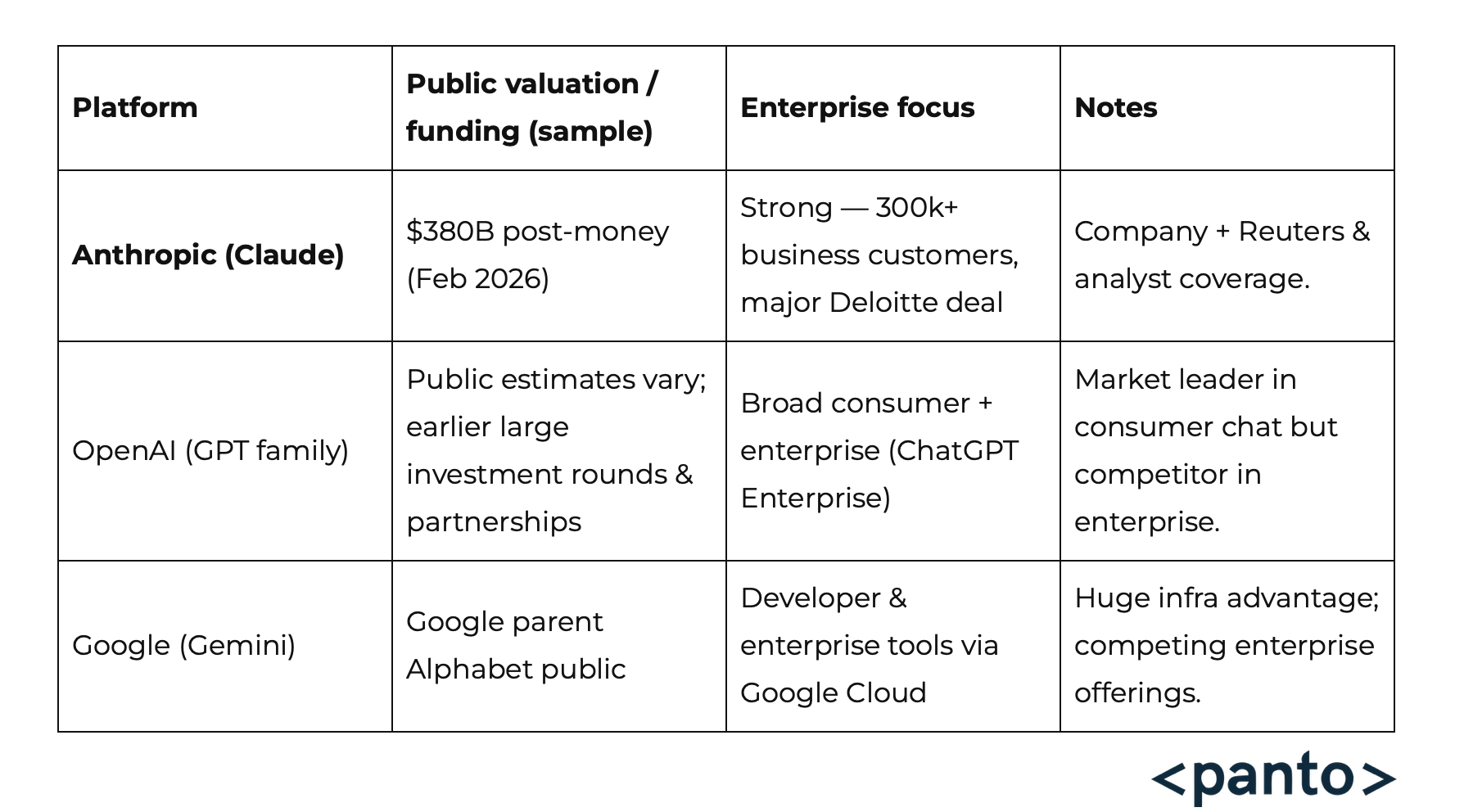
Agentic AI — systems capable of planning tasks and executing them with limited human input — is emerging as a central trend. Developers are also consolidating text, images and audio capabilities into unified multimodal systems designed to work across enterprise workflows.
The Hardware Arms Race
The computational demands of modern AI models continue to drive massive hardware innovation. Nvidia unveiled its Vera Rubin platform powered by H300 GPUs designed to support trillion-parameter models while lowering training costs and improving inference efficiency.
AMD expanded its Ryzen AI 400 series processors for laptops, adding upgraded neural processing units designed to run AI models directly on consumer devices. Samsung also announced plans to embed Google’s Gemini AI into roughly 800 million devices by the end of 2026, including smartphones and smart appliances.
Industry analysts estimate global spending on AI infrastructure could reach between $650 billion and $700 billion in 2026, reflecting the massive capital flowing into data centers and compute capacity.
Regulators Step In
Governments are increasingly asserting authority over AI systems as concerns about misinformation, privacy and security grow. A new law in Vietnam that took effect on March 1 requires AI-generated images and videos depicting real individuals to include clear labeling identifying them as synthetic media.
Elsewhere in Europe, Italy, Denmark and the Czech Republic moved to restrict government use of China’s Deepseek AI models due to concerns about data security and potential foreign influence. The decisions highlight growing geopolitical tension surrounding advanced AI technologies.
Tech Giants Form Strategic Alliances
Corporate partnerships are also reshaping the competitive field. Apple and Google are collaborating to integrate Gemini AI into Apple’s Siri assistant, allowing the voice platform to analyze on-screen content and respond with more context-aware information.
As a researcher following the AI landscape, I’ve been watching the recent integration with great interest. Announced earlier this year, it feels like a really important step forward in making AI accessible to everyday users. What’s particularly noteworthy is how major tech companies are starting to work *with* each other’s systems – it shows they’re willing to break down barriers to stay competitive in this fast-moving AI race.
Billions Flood the AI Economy
Investment in AI remains staggering. OpenAI recently secured $110 billion in funding tied to its “Project Stargate” supercomputing initiative designed to power next-generation AI models.
Venture capital investment has increasingly concentrated in AI startups, with analysts estimating that roughly 90% of February’s global venture funding flowed into artificial intelligence companies.
Consumers Start Picking Sides
Public sentiment is also becoming a powerful factor in the AI race. Anthropic’s Claude climbed to the No. 1 position on the U.S. App Store during the week, partly fueled by backlash surrounding reports of OpenAI’s connections to Pentagon initiatives.
This increase indicates that how people feel about the responsible development of AI could play a big role in which AI-powered platforms become popular as these tools are used more and more in our daily lives.
Other AI Developments Worth Watching
Additional developments included Huawei unveiling an AI-native telecom operations framework at Mobile World Congress designed to improve network reliability. Researchers also introduced a system called Psychadapter, which enables large language models to mimic personality traits and psychological characteristics with high accuracy.
This technology allows for incredibly customized digital assistants, but it also brings up important ethical concerns. These include the possibility of AI convincingly imitating people, influencing behavior, and how far we should go when designing artificial intelligence.
FAQ 🤖
- What were the biggest artificial intelligence stories this week?
Major developments included new AI models from Google, OpenAI, Anthropic and xAI, alongside large funding rounds, regulatory action and new hardware platforms. - Why is the AI industry shifting toward deployment?
Companies are focusing on enterprise adoption, reliability and revenue generation as businesses integrate AI into daily operations. - What new AI regulations took effect recently?
A law effective March 1 requires AI-generated media depicting real people to be clearly labeled as synthetic content. - Why is Anthropic’s Claude gaining popularity with users?
Consumer interest increased after debates about ethical AI use, pushing some users toward platforms perceived as prioritizing responsible development.
Read More
- OKB PREDICTION. OKB cryptocurrency
- Ripple’s 2026 Crypto Prophecy: A Tale of Stablecoins and AI!
- BTC PREDICTION. BTC cryptocurrency
- EUR NZD PREDICTION
- ADA PREDICTION. ADA cryptocurrency
- EUR TRY PREDICTION
- GBP CNY PREDICTION
- USD BGN PREDICTION
- USD UAH PREDICTION
- PEPE PREDICTION. PEPE cryptocurrency
2026-03-05 23:28