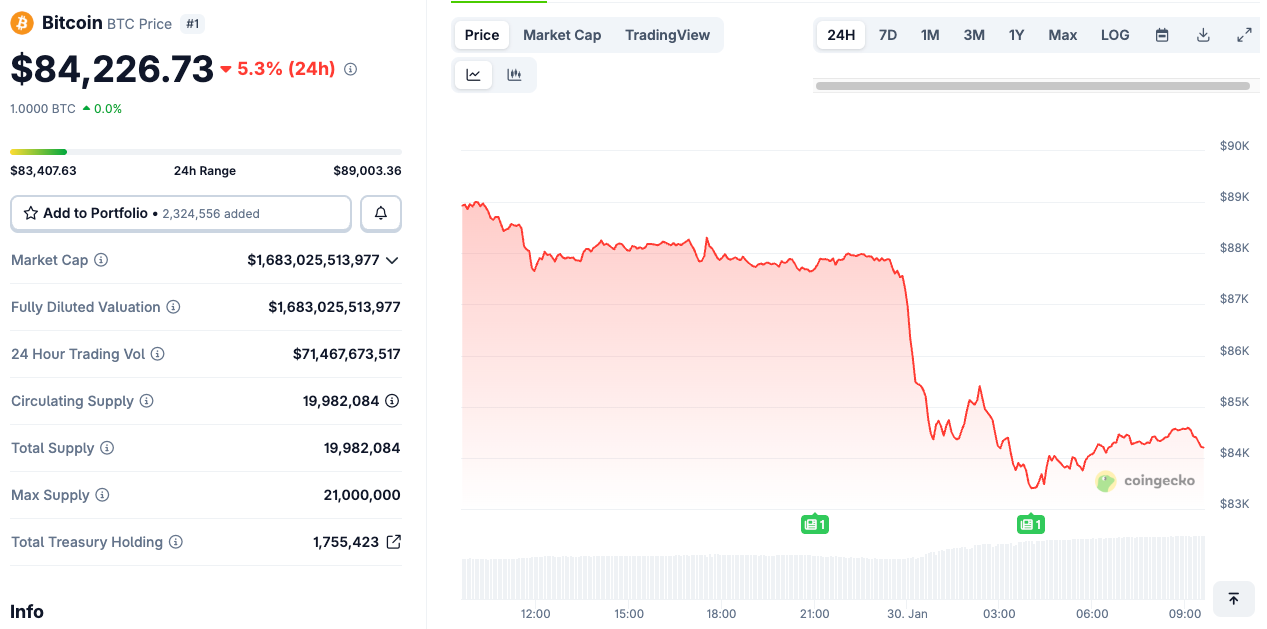
In a rather theatrical turn of events, Bitcoin took a nosedive on Friday morning-Asian time, no less! The plucky cryptocurrency plummeted more than 5%, tumbling from a dizzying $89,000 to a mere $83,400 during the bustling hours of U.S. trading. Unlike its golden counterpart, which managed to pull itself together, Bitcoin seems to be grappling with a rather embarrassing identity crisis, one that would make even the most seasoned existentialist raise an eyebrow.
As the market busies itself re-evaluating trust in currencies and institutions, it appears that the faith is being funneled straight into the impenetrable vaults of gold rather than the whims of crypto wallets. It’s as if the digital gold forgot its lines in a play about currency.
Same Storm, Different Outcomes
The sell-off was ignited by a delightful escalation of tensions between the U.S. and Iran, courtesy of President Trump’s impassioned warnings on Truth Social-because nothing says diplomacy quite like a tweet threatening military strikes unless Tehran plays nice with a nuclear deal. Meanwhile, Middle Eastern governments, bless their hearts, are attempting to mediate, but their efforts are as effective as a chocolate teapot amidst increasing U.S. military presence. Oh, and let’s not forget the looming government shutdown adding a cherry on top of this risk-averse sundae.
Gold, true to its dramatic nature, responded with extreme volatility-dropping 7% to $5,250 in a matter of minutes before executing a jaw-dropping V-shaped recovery. According to the Kobeissi Letter, gold’s market cap swung by an astonishing $5.5 trillion in a single session-the largest daily swing in history. By the time the sun set on Friday’s Asian trading, spot gold had clawed its way back above $5,400, up a modest 1%. A true tale of resilience!
This is absolutely insane:
Gold just posted its largest daily swing in market cap in history, at $5.5 TRILLION.
Between 9:30 AM ET and 10:25 AM ET, gold lost -$3.2 trillion in market cap, or -$58 billion PER MINUTE.
Then, between 10:25 AM ET and 4:00 PM ET, gold added back…
– The Kobeissi Letter (@KobeissiLetter) January 29, 2026
Meanwhile, U.S. equities decided to hold on for dear life. The Nasdaq only shed a mere 0.7%, likely still recovering from Microsoft’s 10% plunge due to AI spending concerns. On the flip side, Meta enjoyed a delightful 10% surge on robust earnings, while the Dow, in a show of defiance, closed slightly positive.
Bitcoin, however, spun quite the different yarn. It sank to $83,400 and only managed a feeble bounce to $84,200-far from the impressive recoveries of gold or the tech sector’s selective jubilation.
A Mania in Precious Metals, but Not in Bitcoin
The contrast couldn’t be starker. Gold has risen over 25% this month alone, nearly doubling since Trump’s second term began a year ago. Silver, that cheeky precious metal, has nearly quadrupled since April’s “liberation day” tariffs, soaring from below $30 to over $118 an ounce. Analysts have taken to describing these price movements as parabolic-surely a sign of speculative mania akin to the most raucous of parties.
Analysts suggest the rally in precious metals reflects more than mere short-term stress; it signals eroding confidence in currencies, institutions, and the post-Cold War economic order. Quite the sociopolitical cocktail, indeed!
Trump’s aggressive policies-punitive tariffs, threats against Greenland (yes, Greenland), and mounting pressure on the Federal Reserve including the pièce de résistance, a criminal case against Chair Jerome Powell-have driven investors toward traditional safe havens. Meanwhile, the dollar has decided to take a leisurely stroll to a four-year low against a basket of currencies.
Central banks have been sneaking gold into their reserves as a modest diversification away from U.S. Treasuries while retail investors, lured by the siren song of safety and momentum, have joined the fray.
Structural Weakness Underneath
Yet, our dear Bitcoin, which once basked in the limelight as a hedge against currency debasement, has failed to join the buying spree. How very anticlimactic!
The price action has laid bare vulnerabilities festering in the crypto markets. Bitcoin spot ETFs have witnessed persistent outflows throughout January, with total assets plummeting from a pinnacle of $169 billion in October to a paltry $114 billion-a staggering 32% drop. One might say Bitcoin is experiencing a rather unfortunate bout of buyer’s remorse.
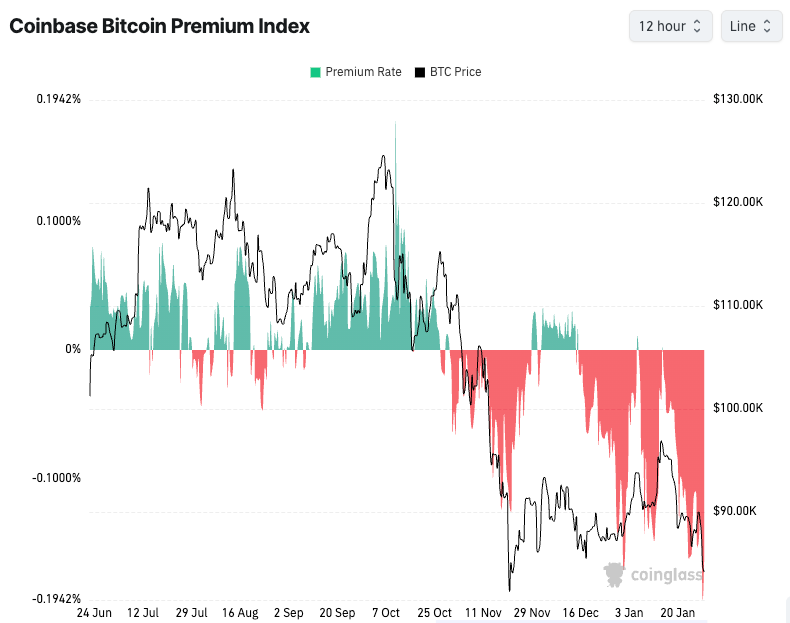
The Coinbase Premium Index, which tracks the price gap between Coinbase and global exchanges-a sort of barometer for U.S. institutional interest-has also turned negative. Both indicators suggest a waning appetite among institutional buyers who once fueled the 2024-2025 rally. A pity, really.
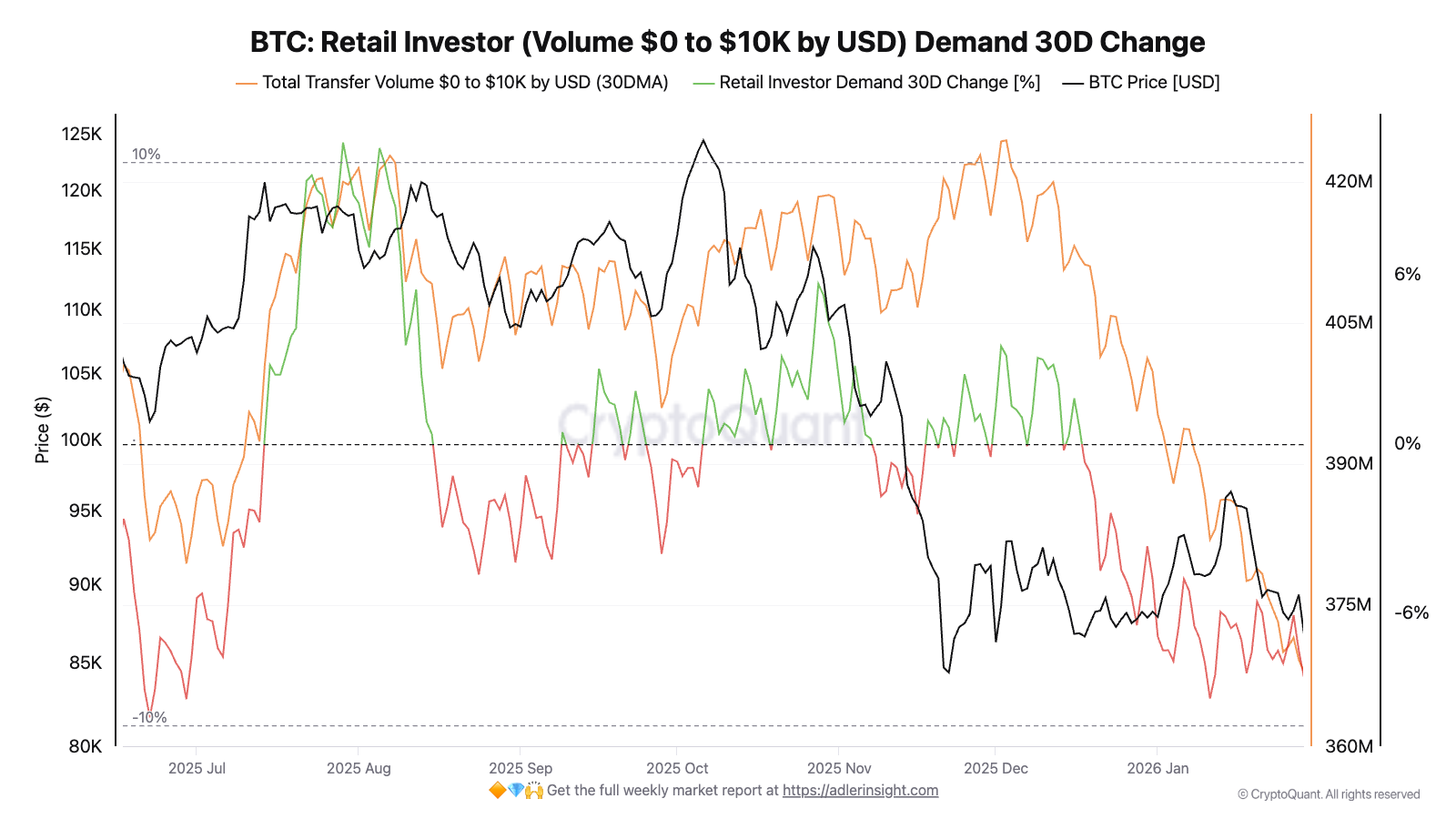
Retail demand has contracted sharply, according to on-chain data. With both institutional and retail buyers stepping back, rallies find it increasingly difficult to maintain momentum while drawdowns become delightfully dramatic.
On the retail front, on-chain data from CryptoQuant reveals small transactions between $0 and $10,000 declining steadily, with 30-day demand growth plummeting from above 10% in October to around -6% now. A truly riveting decline!
With both institutional and retail demand weakening, rallies struggle to sustain their energy while drawdowns become all the more theatrical.
What It Means
Wednesday’s session was nothing short of a real-time stress test. Gold has proven itself the market’s crisis hedge of choice, while tech stocks demonstrated that solid fundamentals can triumph over macro fears. Alas, Bitcoin did neither-absorbing the downside of risk assets while failing to capture the upside of safe havens.
For the “digital gold” narrative to regain its footing, Bitcoin must demonstrate safe-haven behavior when it counts the most. Until such a time, the label remains more of an aspiration than a reality, akin to a grand vision without the means to bring it to life.
Read More
- PayPal’s PYUSD: World Domination or Just Another Coin Flip?
- USD DKK PREDICTION
- 🚀 XRP’s Rocket Ride: From Wallets to Your Stock Portfolio! 🚀
- GBP CHF PREDICTION
- SOL PREDICTION. SOL cryptocurrency
- ETC PREDICTION. ETC cryptocurrency
- XDC PREDICTION. XDC cryptocurrency
- Lithuania’s Crypto Crackdown: Compliance or Chaos? 🏛️💥
- Crypto Drama: Why Is ARB Playing Hard to Get in 2026?
- Trump & Crypto: Revolution or Robbery? 😱 $800M Drama!
2026-01-30 04:51