Ah, the great Donald Trump, with his penchant for drama, has once again taken to the global stage, declaring that the United States and its allies shall send their warships to the Strait of Hormuz. Why, you ask? To ensure the world’s oil flows as smoothly as a Chekhovian monologue, of course, even as Iran threatens to turn the passage into a maritime bonfire.
The Strait of Hormuz: A Stage for Folly and Fireworks
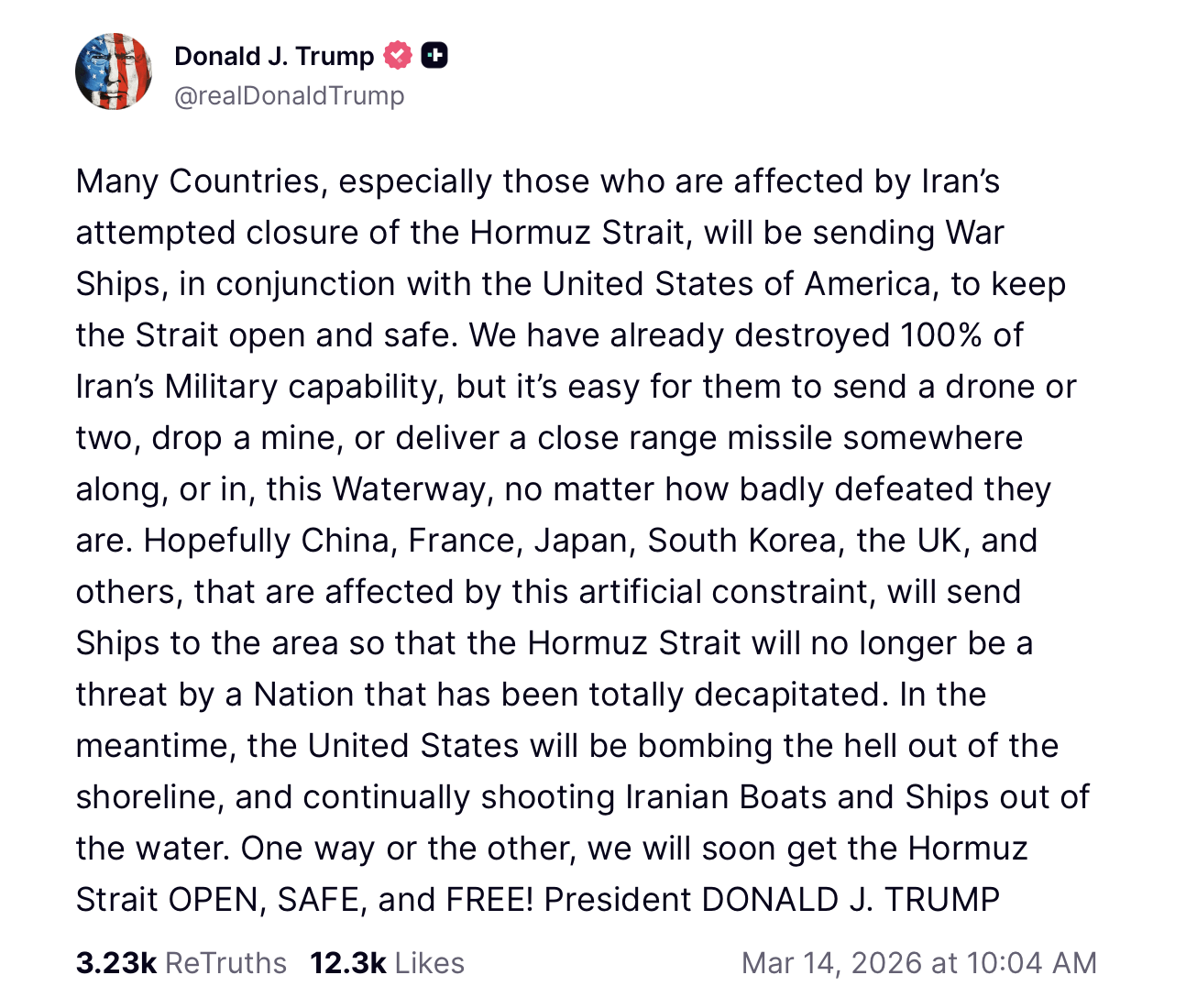
Trump’s March 14 announcement on Truth Social-a platform as subtle as a sledgehammer-landed like a flare in an already combustible theater. The U.S. and “many countries,” he proclaimed, would deploy naval forces to protect ships from Iranian missiles, drones, and other floating unpleasantries. One wonders if the Iranians are simply bored and looking for a new hobby.
This grand gesture comes mere weeks after the U.S. and Israel launched Operation Epic Fury against Iran on February 28. A chain reaction, you see, has now ensnared one of the world’s most vital shipping lanes in its crossfire. How very convenient for those who thrive on chaos.
The Strait of Hormuz, a mere 21 miles wide at its narrowest, is no mere squiggle on a map. It is the lifeline through which oil and liquefied natural gas flow from Saudi Arabia, the UAE, Iraq, Qatar, and Kuwait to the world. Before this latest farce, 20 million barrels of crude passed through daily-one-fifth of the globe’s petroleum consumption. When this artery clogs, the world economy sneezes, and we all catch a cold.
Since early March, Iranian forces linked to the Islamic Revolutionary Guard Corps (IRGC) have reportedly targeted commercial shipping, damaging or abandoning at least 11 vessels. Over 10 seafarers have perished or gone missing, and insurers-those cautious souls-have raised premiums to astronomical heights. Shipping companies, understandably reluctant to star in the next viral disaster, have retreated. Tanker traffic has plummeted, with estimates nearing a 70% decline.
Energy markets, ever the drama queens, have reacted with the grace of a cat encountering a cucumber. West Texas Intermediate crude (WTI), once a modest $67 per barrel, now flirts with the mid-$90 range. Brent crude, ever the prima donna, has surpassed $100 per barrel.
Defense Secretary Pete Hegseth, in a Pentagon briefing on March 13, attempted to soothe nerves. “We have been dealing with it,” he assured reporters. “The only thing prohibiting transit is Iran shooting at shipping.” Ah, yes, a mere technicality. Hegseth also confirmed that U.S. forces have targeted Iranian naval assets, including minelayers and coastal launch positions. How very sporting of them.
The Pentagon claims to have struck thousands of Iranian targets, focusing on degrading their naval capabilities. No wonder Tehran has taken to drones and asymmetric tactics-their conventional fleet is in tatters. How tragically ironic.
Trump, ever the showman, calls for a broader coalition, naming China, France, Japan, South Korea, and the UK as potential partners. A naval ballet, if you will, reminiscent of the 1980s Tanker War, when the U.S. Navy played maritime bodyguard under Operation Earnest Will. But this 2026 reprise is far more complex: swarming drones, anti-ship missiles, and speedboats brimming with malice. Escorting tankers now resembles threading a needle in a fireworks factory.
Gulf producers, meanwhile, feel the ripple effects, scaling back exports or declaring force majeure. Asia, the largest consumer of Hormuz oil, watches nervously, while Europe and global supply chains tremble in the background.
Trump’s Saturday message was characteristically blunt: “We will soon get the Hormuz Strait OPEN, SAFE, and FREE!” he declared. The timeline remains as clear as mud, but until tanker traffic resumes, the global economy-and energy traders-will keep one eye on that narrow strip of water, now feeling far smaller than 21 miles.
FAQ 🔎
- Why is the Strait of Hormuz important to global energy markets?
It funnels 20% of the world’s petroleum liquids daily, making it the most critical chokepoint on Earth. A sneeze there is a flu everywhere else. - Why did President Trump call for warships in the Strait of Hormuz?
To protect tankers from Iranian attacks, which have turned the strait into a maritime minefield. How very thoughtful. - How has the Iran conflict affected global oil prices?
Crude prices have soared as markets price in the chaos. Traders, ever the pessimists, are having a field day. - Could international naval escorts reopen the Strait of Hormuz?
Perhaps, but modern threats-drones, missiles, and rogue speedboats-make it less a ballet and more a game of cat and mouse.
Read More
- LSETH PREDICTION. LSETH cryptocurrency
- USD AUD PREDICTION
- USD ZAR PREDICTION
- AVAX PREDICTION. AVAX cryptocurrency
- GBP RUB PREDICTION
- USD VND PREDICTION
- ETC PREDICTION. ETC cryptocurrency
- CRV PREDICTION. CRV cryptocurrency
- Will Bitcoin Explode to $200k or Crash in 2026? 🚀💣
- Crypto Chaos: $76M Vanishes in December’s Wild Ride! 🚀💸
2026-03-14 20:57