Ah, quantum computing. The stuff of sci-fi movies and, apparently, the latest in Bitcoin‘s long list of existential threats. A brand-new research paper from ARK Invest and Unchained tackles one of the most persistent questions in the world of crypto: Could these mind-boggling quantum computers actually break Bitcoin’s cryptography? Hold on to your digital wallets, folks, because this is about to get both theoretical and mildly terrifying.
The authors of this paper, Dhruv Bansal, Tom Honzik, and David Puell (you know, the usual suspects when it comes to crypto research), conclude that while quantum computing is a legitimate long-term concern, it’s about as much of a threat to Bitcoin right now as a paperclip is to a steel safe. The current quantum systems are still far from being able to compromise Bitcoin’s cryptographic foundations. Not today, quantum overlords.
Bitcoin Quantum Threat Is Distant, Not Immediate
The report’s central thesis is pretty straightforward: Quantum computing could become a risk-just not anytime soon. In fact, it’s more of a “Hey, that might be a problem in 20 years” type of thing, rather than something that’s going to ruin your morning coffee.
“Our two central arguments are as follows,” the authors explain. “Quantum is a long-term risk but not an imminent threat. The community must continue to research and make plans for protecting the network as quantum computers improve.” In other words, Bitcoin isn’t going to wake up one morning and find itself hacked by an overly ambitious quantum machine. It’s more like the slow creep of a really inconvenient problem, like your inbox filling up with spam.
They even go on to say that even if quantum breakthroughs occur, using them to attack Bitcoin would be costly and painfully slow. Imagine trying to run a marathon while carrying a refrigerator-basically, that’s how hard it would be to break Bitcoin using quantum computing. But hey, in the world of crypto, slow and costly sounds like a win.
In practical terms, the report points out that today’s quantum machines are like the early-stage prototypes of a car, but you’re still working out the kinks-like, say, figuring out how to make it go in a straight line. These devices operate in what the researchers call the “NISQ era,” which sounds like something you’d order at a fancy coffee shop, but actually refers to machines with limited logical qubits and high error rates.
Breaking Bitcoin’s cryptography would require quantum systems that are… well, better. To make a dent, you’d need at least 2,330 logical qubits and millions (if not billions) of quantum gates. For reference, today’s systems are barely scraping together 100 qubits. So, yeah, Bitcoin’s cryptography is safe for now-unless, of course, you’re still worried about your email password.
Instead of some sudden technological apocalypse, the paper outlines a series of milestones in quantum development. Early stages will involve quantum systems with absolutely no commercial application whatsoever-kind of like the early days of the internet, when no one really knew what the heck to do with it. Later phases might see quantum computers solving problems in chemistry or materials science, long before they could ever think about breaking cryptography. So, no, you won’t see quantum computers invading Bitcoin anytime soon.
Eventually, though, quantum computers could reach a stage where they might pose a threat to Bitcoin. But don’t worry; by that time, Bitcoin’s 10-minute block interval might give us plenty of time to run around screaming and figuring out a solution. As the researchers put it, quantum development will be more like a slow, steady march than an all-out “Q-day” event. Plenty of time for everyone to panic later.
And, just to keep things in perspective, the paper also notes that if quantum attacks were ever viable, the broader internet security ecosystem would likely be the first to get disrupted. So, Bitcoin would probably just be one of many problems in a very, very long list of things to fix. At least we’ll be in good company.
The report also takes a moment to guesstimate just how much Bitcoin could theoretically be at risk if quantum computing were to, you know, actually start being good at its job. According to their analysis, roughly 1.7 million BTC stored in older P2PK address types are exposed but likely lost forever (because we all know how bad humans are at backing up). Another 5.2 million BTC is in address formats that could be upgraded if necessary, so it’s not all doom and gloom. The researchers conclude that around 35% of the total supply could theoretically be at risk-although, as they wisely point out, many of those coins are inactive or can be moved to safer formats. In short, not a big deal… for now.
Governance And Upgrades Remain Open Questions
Okay, so the technical threat is years away, but the real fun might be in governance challenges. If and when the time comes to adopt post-quantum cryptography, upgrading Bitcoin’s cryptographic primitives will require everyone and their dog to agree on it. Developers, miners, node operators, and the entire Bitcoin community will need to unite in harmony-something that seems as likely as a cat becoming a dog, but hey, miracles happen.
The paper also raises questions about what happens to coins whose public keys are already exposed on-chain. Should they be left to fend for themselves? Should they be restricted? Should we just hope quantum attackers are feeling merciful? Who knows! The debate is still open, like a mystery novel with no ending.
But ultimately, the researchers conclude that quantum risk is a long-term engineering problem, not something that’s going to blow up Bitcoin in the next 10 minutes. “Quantum risk will evolve over time,” they say, “and with plenty of warning signals and decision points along the way.” So relax, everyone. Bitcoin’s still safe, and you can keep that cold wallet buried under the floorboards for a little while longer.
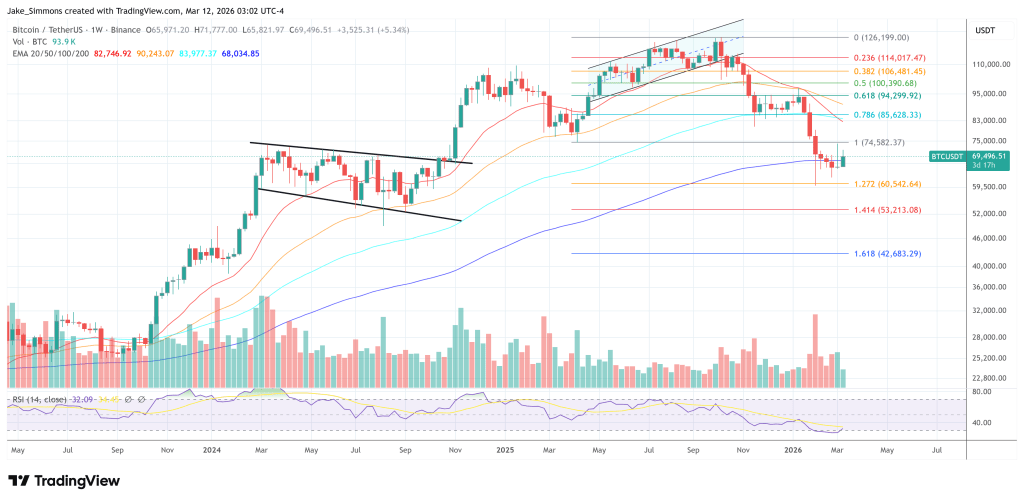
At press time, Bitcoin was trading at $69,496. Just another day in the life of a decentralized digital currency that may or may not be doomed by quantum computers. Stay tuned.
Read More
- LSETH PREDICTION. LSETH cryptocurrency
- AVAX PREDICTION. AVAX cryptocurrency
- EUR TRY PREDICTION
- USD CLP PREDICTION
- DOGE PREDICTION. DOGE cryptocurrency
- USD ZAR PREDICTION
- USD RUB PREDICTION
- EUR MXN PREDICTION
- TIA PREDICTION. TIA cryptocurrency
- GBP RUB PREDICTION
2026-03-12 14:41