Bitcoin is under pressure again, this time due to rising tensions in the Middle East and the impact on global financial markets. Instead of reacting to individual news stories, investors are responding to a general increase in uncertainty, changing expectations about available money, and adjustments to their investment strategies across different assets. Bitcoin’s price is unstable, and attempts to push it higher are failing as investors re-evaluate their holdings in this volatile situation.
A new report from CryptoQuant highlights a change in how short-term Bitcoin investors are behaving. The report focuses on the amount of Bitcoin these investors (who often cause quick price swings) are sending to exchanges. Typically, they move their coins to exchanges when they’re experiencing losses, which can signal increased market stress.

During a sharp sell-off on February 5th and 6th, long-term Bitcoin holders (STHs) quickly moved around 89,000 BTC to exchanges, accepting losses – a strong indication of widespread fear and selling. However, this trend has changed since then, with fewer and fewer loss-driven transfers to exchanges.
It looks like the initial rush of sellers—those who recently bought and are now trying to cut their losses—is slowing down. The intense, panicked selling seems to be over. We’re not seeing a strong surge of new buyers, but rather a shift from desperate selling to a point where the market is becoming less reactive – a small but significant change in how things are unfolding.
Short-Term Holders Show Restraint As Geopolitical Stress Fails To Trigger New Capitulation
Looking closely at profits and losses from short-term Bitcoin holders on different exchanges gives us a more detailed understanding of what’s happening in the market. Despite recent tensions involving Iran – which usually causes investors to sell and reduce risk – we didn’t see a significant increase in Bitcoin being sent to exchanges by these short-term holders. Even as Bitcoin’s price tested the $63,000-$64,000 range, there wasn’t a jump in people selling at a loss. This is unusual, as short-term holders are typically very quick to react to price swings.

Based on what I’m observing, the market seems to be moving from immediate, panicked selling to a more measured approach where people are holding on to their coins unless conditions worsen. In the past, similar price drops would trigger a large wave of coins being sent to exchanges as people tried to cut their losses. The fact that we *aren’t* seeing that now suggests that a lot of the forced selling probably already happened during the big price drop we saw in early February. It looks like those who *had* to sell have mostly done so.
Markets usually become stable once those who were forced to sell due to losses have finished selling. The continued decrease in forced selling suggests that the pressure from liquidations is lessening, rather than increasing.
From now on, the key thing to watch is how long investors hold onto their assets. If we don’t see many new, short-term investors buying, it suggests sellers are losing steam and a stable base is forming. However, if we suddenly see a lot of investors selling at a loss, it means the recent selling isn’t over, and prices could fall further.
Bitcoin Hovers Near Long-Term Support As Weekly Structure Remains Fragile
Bitcoin is currently trying to find support around $66,000 after failing to break through the $90,000-$100,000 range. The market appears to be shifting from a period of growth to a correction. After reaching highs in late 2025, the price started making lower highs and eventually dropped below the 50-week moving average, which had previously provided consistent support during the upward trend.
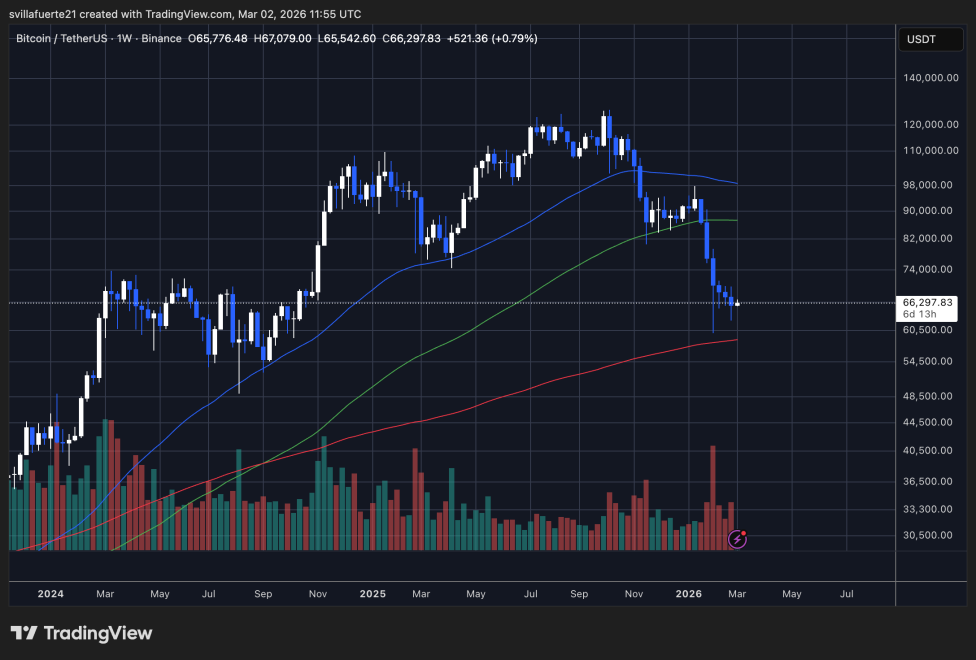
As an analyst, I’ve been watching Bitcoin closely, and the recent drop below the 100-week moving average really picked up the downward momentum, quickly pushing prices toward the mid-$60,000s. This level is now a key area to watch. The 200-week moving average, currently around the low-$60,000s, is still holding as support, but the price is getting dangerously close. Historically, when Bitcoin closes consistently below this 200-week average, it’s often a sign of larger, more significant weakness in the market.
Trading volume significantly increased during the recent steep price drops, which points to panicked selling and forced liquidations rather than investors slowly selling off their holdings. However, the latest price action shows smaller price changes and less downward pressure, suggesting a temporary balance.
Currently, the $69,000–$70,000 price range is acting as a strong barrier to further gains, as this is an area where the price previously found support but now faces selling pressure. If the price can rise above this level on a weekly chart, it would suggest a potential recovery. However, if the price falls below the $62,000–$64,000 range, it could signal a larger price decline.
Read More
- EUR CNY PREDICTION
- USD CAD PREDICTION
- TAO PREDICTION. TAO cryptocurrency
- USD UAH PREDICTION
- USD CNY PREDICTION
- POL PREDICTION. POL cryptocurrency
- USD THB PREDICTION
- VET PREDICTION. VET cryptocurrency
- CNY RUB PREDICTION
- USD KRW PREDICTION
2026-03-03 04:15